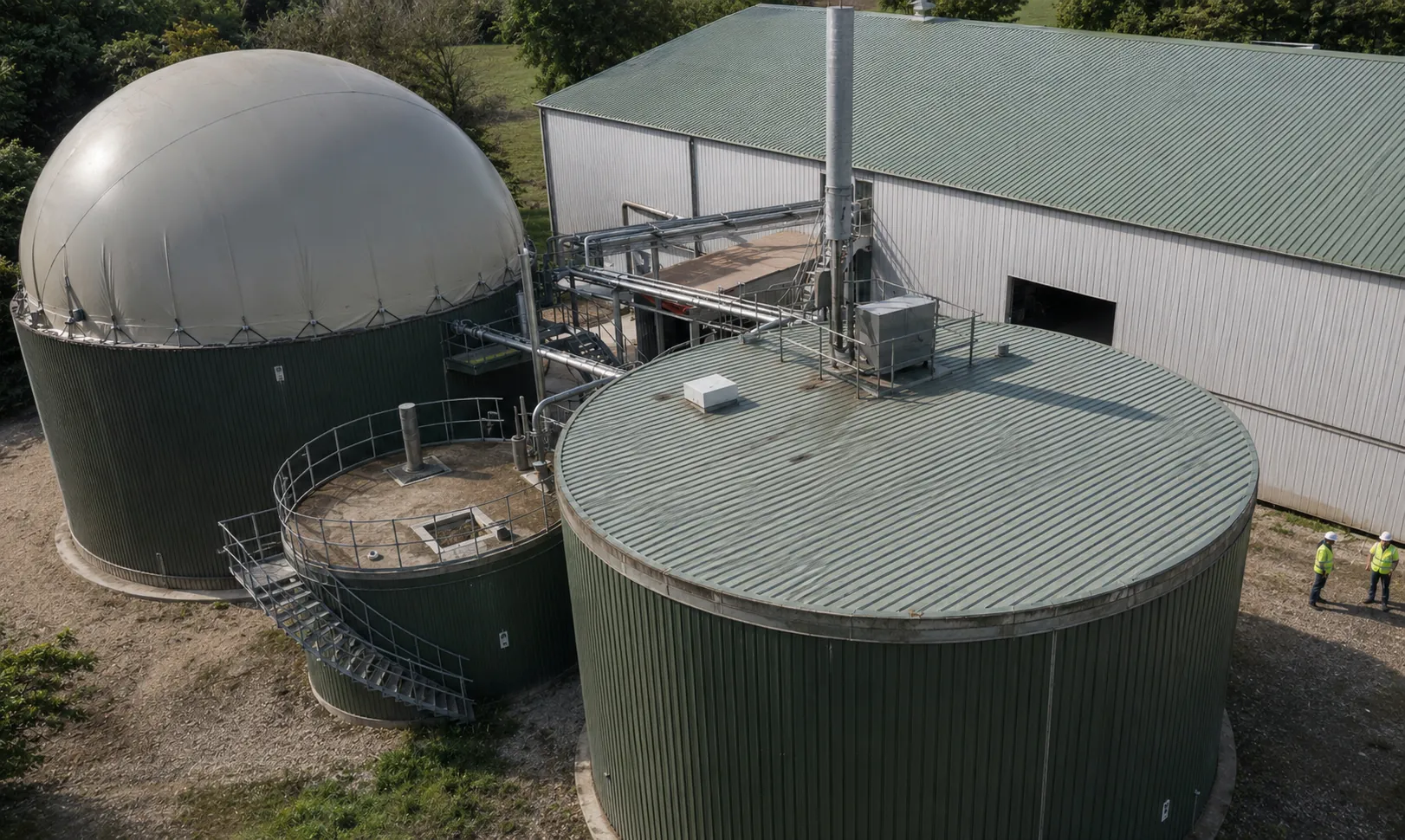
Hydrogen from organic waste, made on site
Modular reforming turns biomethane into high purity hydrogen where it is used, removing the deliveries, the road miles and the carbon that come with trucked in supply.
- Typically 10 – 1,000 Nm³/h
- Modular capacity range
- Up to > 99.999%
- Hydrogen purity (> 5.0 grade)
What it is
A Steam Methane Reforming (SMR) process combined with high efficiency Vacuum Pressure Swing Adsorption ((V)PSA). Together they convert gaseous hydrocarbons into high purity hydrogen. The feedstock is clean biomethane from anaerobic digestion, so the system runs inside a circular energy loop.
- 01
Desulphurisation
A dedicated stage strips impurities from the feedstock.
- 02
Reforming
The feedstock reacts with steam over a precious metal catalyst.
- 03
Water-Gas Shift
Residual carbon monoxide is converted.
- 04
Purification
A multi vessel (V)PSA system purifies the stream.
Waste heat and off gases are fully recycled internally to power the reformer burner. Thermal efficiency stays high and no external fossil fuel is needed.
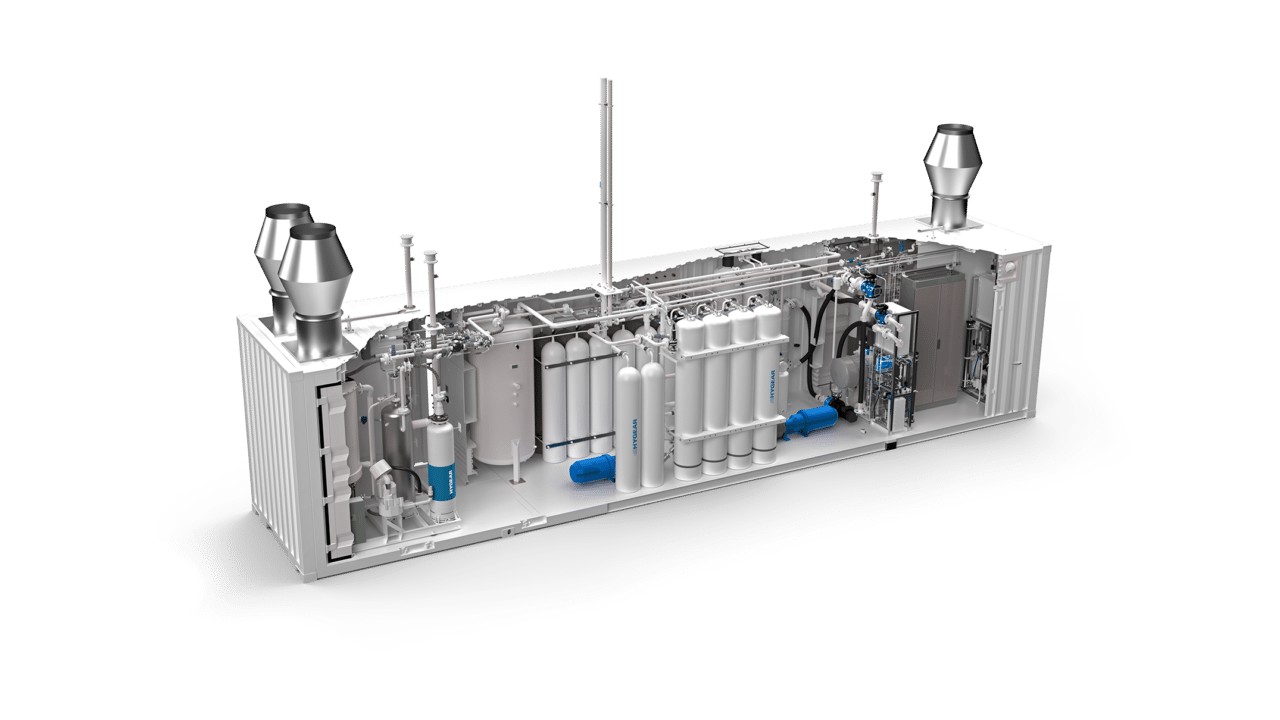 Open the render full size
Who it is for
For industrial users, utilities and commercial operators who need an uninterrupted supply of high purity hydrogen on site. It removes the delivery risk and the carbon cost of bulk tube trailer supply.
Flat glass and metal industries
Requiring continuous reducing atmospheres.
Chemical and food hydrogenation plants
Needing steady chemical feedstock.
Semiconductor and electronics manufacturers
Demanding ultra high purity gas streams.
Hydrogen refuelling stations (HRS)
Requiring reliable, localised fuel production capacity.
Feedstocks, outputs and scale
What goes in, what comes out, and how far the system scales.
- Hydrogen purity
- Up to > 99.999%
- > 5.0 grade, fully qualified for high end industrial and mobility applications.
- Modular capacity range
- 10 – 1,000 Nm³/h
- Typically, for small to medium scale on site generation using parallel containerised units.
Feedstocks
- Primary hydrocarbon input
- Biomethane
- Upgraded biogas from anaerobic digestion or landfill gas, which allows carbon neutral operation. Conventional natural gas can run alongside it during transition phases.
- Auxiliary inputs
- Process water and electricity
- Demineralised or purified process water for steam generation, and electricity solely for system controls, instrumentation and balance of plant auxiliaries.
Outputs
- Hydrogen purity
- Up to > 99.999% (> 5.0 grade)
- Fully qualified for high end industrial and mobility applications.
- By-products and co-products
- Biogenic carbon dioxide
- A concentrated stream when using biogas or biomethane feedstocks. It can be captured downstream, then used or permanently sequestered, giving a carbon negative profile.
Scale
- Modular capacity range
- Typically 10 Nm³/h up to 1,000 Nm³/h
- Small to medium scale on site generation, using parallel containerised units.
- Turnkey footprint
- Skid mounted or containerised
- A compact layout for rapid site installation, with a minimal civil engineering footprint.
The Hy.GEN® series, built by HyGear
Aurion+ deploys, integrates and operates the Hy.GEN line. It is modular, containerised hydrogen generation for use on site, built around steam methane reforming.
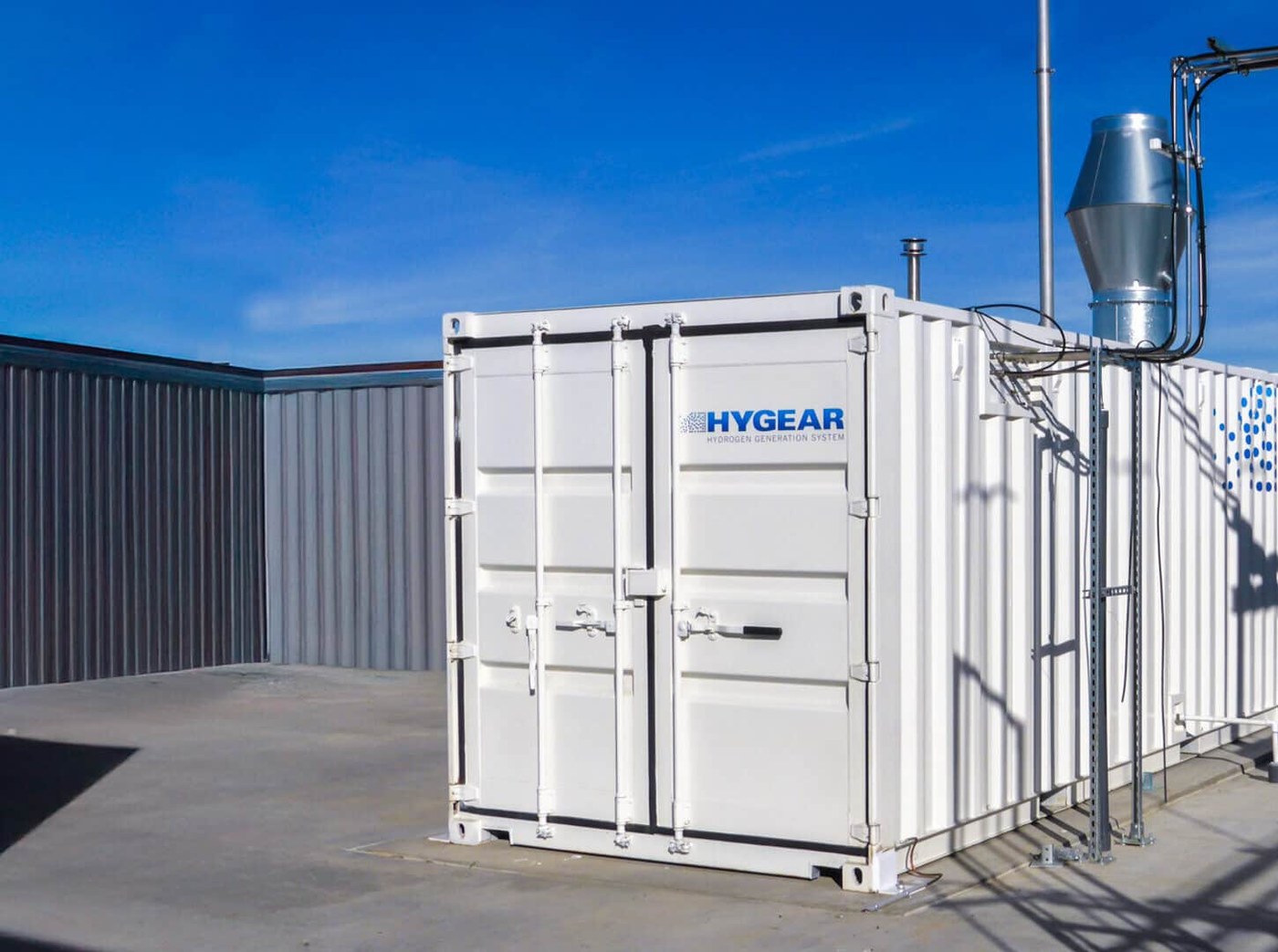
Capacity range of 10 Nm³/h to 1,000 Nm³/h, using parallel containerised units.
The Hy.GEN 50, 100 and 150 frameworks.
Skid mounted or containerised architecture, for rapid installation with minimal civil engineering footprint.
Purity up to > 99.999% (> 5.0 grade), fuel cell grade.
The Hy.GEN Grand® is the large scale variant, using an electric reformer with carbon capture included as standard.
Technology partner

Aurion+ deploys, integrates and operates Hy.GEN systems as part of complete on site hydrogen supply.
Product imagery courtesy of HyGear, and shows the manufacturer’s equipment rather than an Aurion+ installation.
How it complements electrolysis
Baseload hybridisation
Reforming biogenic gas bridges the intermittency of renewable power. Where alkaline electrolysis depends directly on variable green electricity, biogas reforming runs continuously 24/7, providing steady baseload chemical conversion.
Capital and energy optimisation
Running both technologies together makes a hybrid microgrid possible. Biogas reforming provides the guaranteed baseline output, and electrolysis scales up when surplus low cost renewable power is available.
Unified infrastructure
Both systems share the same downstream gas conditioning, compression, buffer storage and safety control approach. That shortens operator training and simplifies balance of plant maintenance across a mixed asset energy hub.
The other route
Pressurised alkaline electrolysis is the production route this system runs alongside.
See hydrogen productionIn a project
The Dry Anaerobic Digestion system at Project Cendana in Peninsular Malaysia is an application of this biogas pathway, turning regional palm waste into baseload power for the site.
See Project Cendana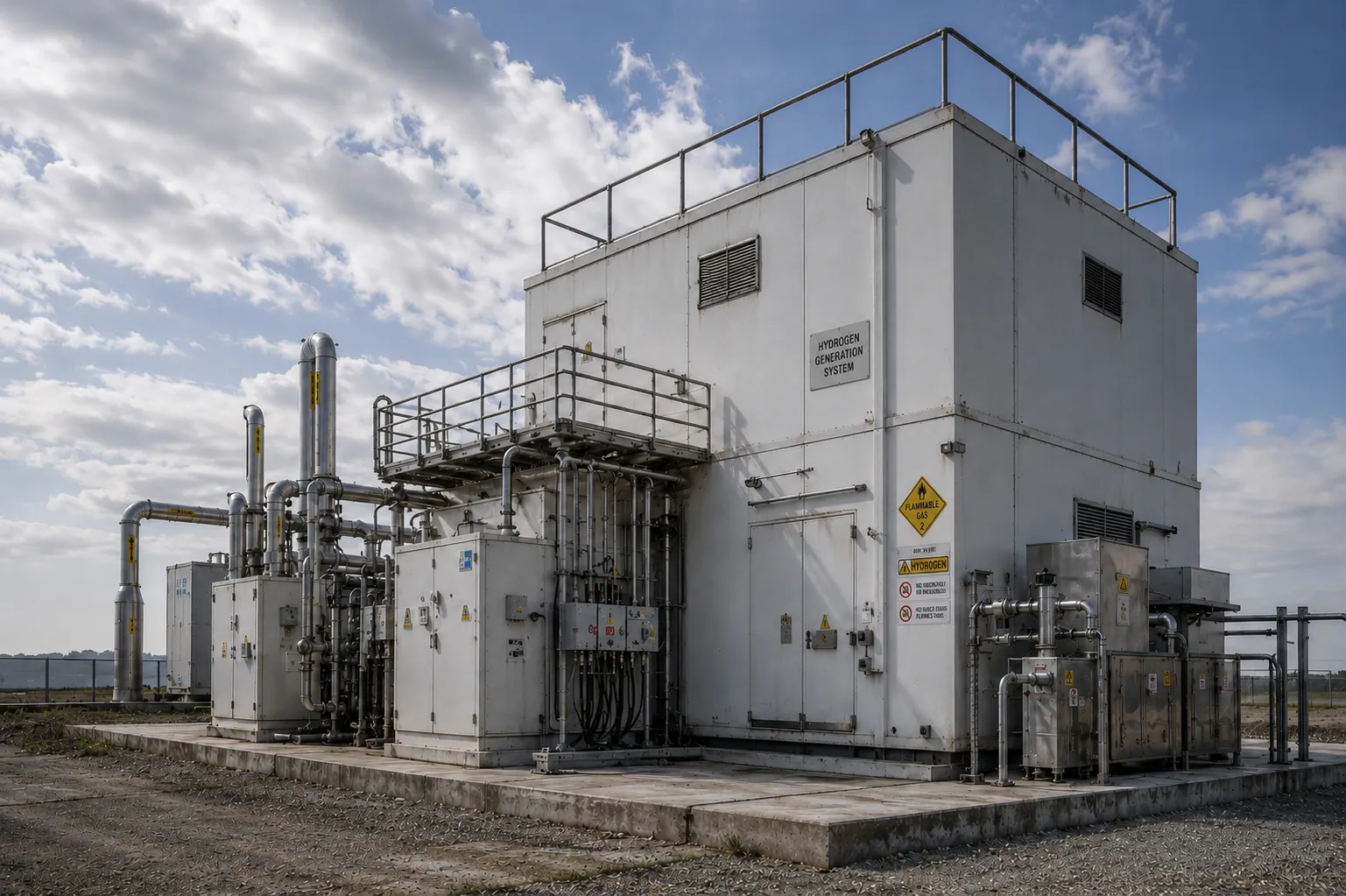
The electrolysis route
Reforming runs alongside pressurised alkaline electrolysis, from a single module to a full array.
Explore hydrogen production